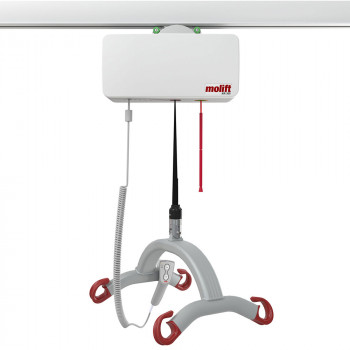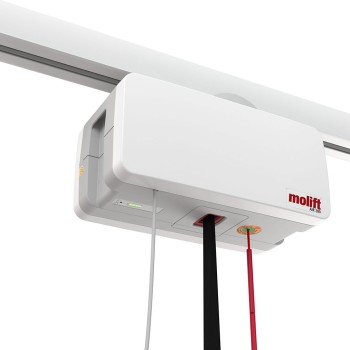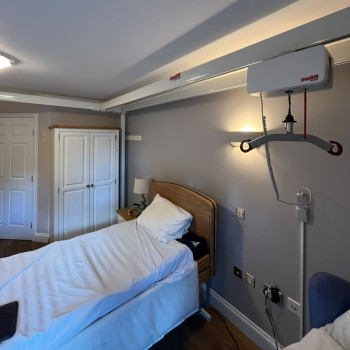
How to use a ceiling track hoist to get off the floor
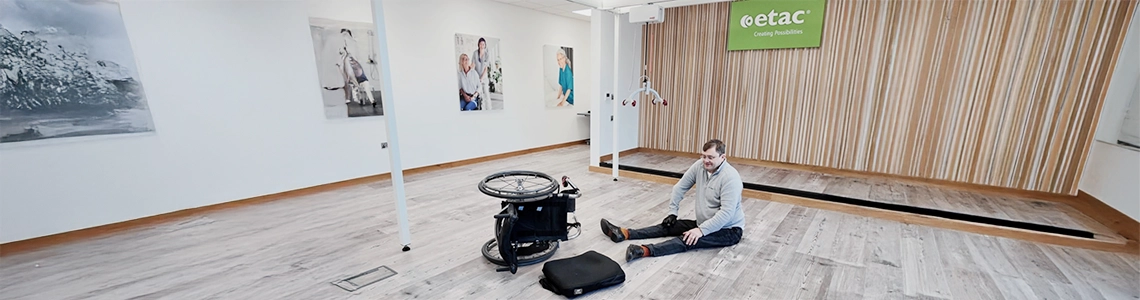
How to Use a Ceiling Track Hoist to Get Off the Floor: An Occupational Therapy Perspective
A fall at home can be stressful, and for the person on the floor and the people around them, the first instinct is often to get up as quickly as possible. From an OT’s point of view, that instinct needs managing. Getting someone off the floor safely is a sequence: check, plan, then move. A ceiling track hoist can be one of the safest ways to complete that sequence, but only when the person, the equipment and the environment have all been properly assessed.
This article explains how a ceiling track hoist is used for floor recovery, what NHS and national guidance says, and where an OT assessment makes the difference.
Step One: is a hoist the right choice?
Not every fall ends with a hoist. Local NHS post-falls guidance generally starts with the least invasive option. If the person is not seriously injured, they may be able to get up themselves with minimal support, using a staged approach that involves rolling to side-sitting, moving into four-point kneeling, and rising with the help of a sturdy chair [2].
Where that is not possible, the same guidance says a hoist may be a safe way to support someone off the floor, but staff should consider three questions first: how well will the person tolerate a hoist, could it make things worse, and is there room to bring the equipment in safely [2]. A community fallen-person protocol used by health and council staff in Lincolnshire sets out the same options, listing a hoist with an appropriate sling (mobile or ceiling track, depending on the situation and the equipment available) alongside assisted self-recovery [4].
The takeaway: a hoist is a good option, not an automatic one.
Check for injury before anyone moves
Local NHS guidance is consistent on one point: the person should be checked for injury before they are moved. Stay with them, keep them warm, comfortable and reassured, and look for signs that this is an emergency [3][4].
Typical red flags include a blow to the head, new confusion, severe headache, vomiting, neck or back pain, new limb weakness, or a leg that looks shortened or turned out. Anyone on blood-thinning medication who has hit their head needs particular care. If any of these are present, do not hoist. Call 999 or follow your local pathway, and keep the person warm and comfortable while you wait.
Time also matters. Local NHS guidance warns that a long lie on the floor can itself be harmful [3], so if the person is uninjured, plan to move them without unnecessary delay.
What needs to be in place before a fall happens
Most of what makes floor recovery safe happens long before the fall, and this is where OT input is most valuable.
- Track coverage and drop. Does the track reach the places where the person is likely to fall, such as the bedroom, bathroom or hallway? Does the lifting strap have enough drop to reach the floor? Not all ceiling hoists do, so this needs to be confirmed at assessment rather than discovered after a fall.
- The right sling. The sling must suit the person’s size, posture and condition, and must be compatible with the hoist. A National Patient Safety Alert on patient hoists and slings highlights incompatible hoist and sling combinations, including third-party slings not validated for the specific hoist, as a cause of serious harm [6]. Always use the sling named in the person’s assessment and the manufacturer’s instructions for use.
- Training. Everyone who may need to use the hoist, whether family carers or paid carers, should be shown the process in the person’s own home, including a practice run of a floor recovery where the assessment supports it.
- A written plan. Include the person’s moving and handling risk assessment, who to call, and when not to hoist.
- Servicing and LOLER. Under the Lifting Operations and Lifting Equipment Regulations (LOLER), equipment that lifts people and its accessories, including slings, need a thorough examination by a competent person at intervals of six months or less [6][7]. If a hoist or sling is overdue, it should not be used.
Using the hoist: the process in brief
This is an overview for understanding, not a substitute for training or your own care plan. Follow the manufacturer’s instructions and your local policy.
- Reassure and prepare. Explain what will happen and keep the person warm. Clear the space and bring the destination, usually a bed or chair, as close as practical.
- Get the right number of people. Follow the care plan. Floor recoveries commonly need two trained carers.
- Position the person for the sling. If they are lying away from the track line, do not drag them. A low-friction slide sheet can be used to reposition them in line with the track, as set out in your moving and handling assessment.
- Place the sling. Roll the person gently to one side, position the sling under them according to the instructions for that sling type, and roll them back. Check the labels and the leg and back positioning.
- Attach the sling. Bring the hoist over, lower the strap, and attach the loops as specified, keeping them matched on both sides. Check each attachment before any weight goes on.
- Take up the slack and pause. Raise slowly until the sling is just taut, then stop. Check the positioning and ask the person how they feel. The lifting strap should be vertical, since a diagonal pull can swing or tip the person.
- Lift and observe. Raise the person clear of the floor into a supported, seated position. Pause briefly and look for dizziness, pallor or distress before moving along the track.
- Traverse and lower. Move to the bed or chair, lower the person slowly, and unhook once they are fully supported. Remove the sling unless it has been assessed as safe to leave in place.
- Check again. Once the person is settled, check for pain, new injury and skin damage.
After the lift
The job is not finished when the person is back in bed or the chair. Local NHS guidance advises monitoring for deterioration in the hours after a fall, and staff or carers should know who to contact, which may include the GP, NHS 111 or a local falls service [3]. Record what happened, including the time, the cause if known, and any injuries.
For OTs, a fall is also a prompt to review. Community protocols expect a falls risk assessment to be reviewed after a fall, with prevention measures put in place where appropriate [4].
Preventing the next fall
The NICE guideline on falls (NG249, published in April 2025) covers assessing the risk of falling and interventions to prevent falls in people aged 65 and over, and in people aged 50 to 64 who are at higher risk [1]. It sets out the following areas: identifying people at risk, comprehensive falls assessment, interventions to reduce the risk of falls, and maximising ongoing participation in prevention programmes [1]. OT home assessment, covering lighting, flooring, furniture, equipment and alarms, sits within that picture, and NICE’s tools list even includes an OT home assessment tool, Homefast [1].
The Royal College of Occupational Therapists’ 2020 practice guideline on the prevention and management of falls gives OTs further guidance on their role, and social care OTs are increasingly asked how people can get up after a fall without calling an ambulance when there is no injury [5]. Teaching and practising safe floor recovery techniques, alongside a hoist solution where needed, is part of that conversation.
Key points
- Check for injury first. If in doubt, don’t hoist; get medical advice.
- A hoist is one of several floor recovery options, not the default.
- Confirm at assessment that the track and lifting strap can actually reach the floor.
- Use only the sling that is assessed for the person and compatible with the hoist.
- Make sure the hoist and slings are within their six-monthly LOLER examination.
- Train everyone who might need to use it, and review the falls plan after any fall.
This article is general information and not clinical advice. Every person and every home is different, so always follow your OT’s assessment, the manufacturer’s instructions and your local policy.
References
- NICE (2025). Falls: assessment and prevention in older people and in people 50 and over at higher risk (NG249).
- Nottingham and Nottinghamshire ICB. Shared Post Falls Protocol: supporting documentation.
- BNSSG ICB. Managing a fall that may require an ambulance: falls FAQs poster for care homes (May 2020).
- Lincolnshire County Council and community health partners. Appendix H: Fallen person protocol (community). https://professionals.lincolnshire.gov.uk/downloads/file/844/g12-appendix-h-fallen-person-protocol-community
- Research in Practice. ConnectED Briefing #1: What social care occupational therapists can do to help people (August 2022), which cites Royal College of Occupational Therapists (2020), Occupational therapy in the prevention and management of falls in adults.
- National Patient Safety Alert: Patient hoists and slings (all types): risk of death and serious harm from falls.
- HSE. Lifting Operations and Lifting Equipment Regulations 1998 (LOLER).
Looking at a ceiling track hoist for yourself or someone you support? EnableLiving supplies mobility, patient lifting and independent living equipment across the UK. Call 01772 814555 or visit enableliving.com.